
March 11, 2026

Detailed view of an open music book displaying musical notes and sheet music.

Introduction to Music Theory: The Map to Your Musical World

Many beginners view music theory as a dry, academic subject filled with dusty books and complex math. However, in my 2 years of teaching guitar and piano across Delhi, I’ve seen that theory is actually the “GPS” for your creativity. It doesn’t tell you where to go; it just shows you all the possible roads so you don’t get lost. As a Psychology student, I find it fascinating how our brains crave the patterns that music theory explains. Here is an introductory guide built on the E-E-A-T model to help you understand the “why” behind the notes you play at Strumeasy. 1. Music is a Language (Experience) Think of music theory as the grammar of a language. You can speak a language without knowing grammar, but knowing it allows you to write poetry, tell better stories, and understand others more clearly. The “Ear” vs. “Brain” Debate: I’ve met many self-taught musicians who “play by ear.” While that’s a fantastic skill, they often hit a wall when trying to communicate with other musicians. The Breakthrough: Theory provides the vocabulary. Instead of saying “play that sparkly-sounding thing,” you can say “play a Major 7th chord.” It saves time and frustration during practice. 2. The Building Blocks (Expertise) To understand the big picture, we have to start with the smallest units of sound. Notes and Pitch: In Western music, we use 12 notes. Think of these as the primary colors on your palette. Intervals: This is the distance between two notes. Whether you’re playing a piano or a guitar, the “emotional” quality of a song comes from these distances. A “Minor 3rd” sounds sad, while a “Perfect 5th” sounds powerful and stable. Scales: A scale is just a specific path through those 12 notes. The Major Scale is the foundation of almost everything we hear in popular music today. 3. The Psychology of Sound (Authoritativeness) Why does a C Major chord sound “happy” while a C Minor sounds “sad”? Pattern Recognition: Our brains are hard-wired to look for resolution. When we hear a “dissonant” (tense) interval, our psychology demands a “consonant” (relaxed) resolution. The Math of Emotion: Music theory explains the ratios and frequencies that trigger these emotional responses. Understanding this allows you to intentionally “manipulate” the mood of your listeners—a powerful tool for any songwriter. 4. Theory in Practice (Trustworthiness) I will be honest with you: Learning theory won’t make you a rockstar overnight. It requires consistent application. Don’t Learn in a Vacuum: Never learn a theory concept without immediately finding it on your instrument. If you learn about the Circle of Fifths, find those relationships on your fretboard or keyboard. It’s a Tool, Not a Rule: Some of the greatest songs ever written “break” the rules of music theory. Theory is meant to explain music that already exists, not to limit the music you haven’t written yet. The Beginner’s Theory Roadmap Concept Why it Matters The Major Scale The “Home Base” for 90% of songs. Chord Construction Understanding how to build a chord from a scale. Rhythm & Time The “heartbeat” that keeps the music moving. The Number System How to transpose songs to different keys easily. “Music is the shorthand of emotion.” — Leo Tolstoy At Strumeasy, we don’t just teach you where to put your fingers; we teach you how to understand the music you’re making. Whether you’re in a group class or a 1-on-1 home session in Delhi, we make theory feel like a discovery, not a chore. Would you like me to help you create a “Music Theory Cheat Sheet” PDF that you can offer as a free download for students who visit your new website?

Introduction to Music Theory: The Map to Your Musical World Read More »

A collection of acoustic guitars beautifully displayed in a music store setting.

Things to remember while playing your first chord

The First Chord: 5 Essential Things to Remember The moment you press down your first chord and hear all the strings ring out clearly is a milestone every guitarist remembers. However, for most beginners, that first “Em” or “G” chord sounds more like a series of thuds and buzzes than music. As a music educator with over 2 years of teaching experience in Delhi, I have watched hundreds of students at Strumeasy struggle with the same initial hurdles. By applying a bit of psychological insight into muscle memory and the right technical expertise, you can master your first chord much faster. Here is what you need to keep in mind when your fingers meet the fretboard for the first time. 1. The “Arch” is Everything (Expertise) One of the most common mistakes beginners make is laying their fingers “flat” across the strings. This causes your fingers to accidentally touch (and mute) the strings below them. The Bridge Shape: Your fingers should look like little bridges or arches. The Tip Factor: You must use the very tips of your fingers to press the strings. If you use the fleshy pads, you will naturally lean into other strings. 2. Thumb Placement: Your Hidden Anchor (Experience) In my 500+ hours of 1-on-1 and group teaching, I’ve noticed that most “buzzing” sounds aren’t caused by weak fingers, but by a misplaced thumb. The Mid-Neck Rule: Try to keep your thumb roughly in the middle of the back of the neck, rather than wrapping it over the top (at least for basic chords). The Pincer Grip: Think of your thumb and fingers as a pincer. The thumb provides the counter-pressure that allows your fingers to press down without your hand getting tired. 3. Stay Close to the Metal (Expertise) Where you place your finger within the fret makes a massive difference in how much effort you have to exert. The “Sweet Spot”: Always aim to place your finger just behind the metal fret wire, not directly on top of it and not way back in the middle of the fret. Maximum Leverage: Placing your finger close to the fret wire requires the least amount of pressure to get a clear note. If you’re too far back, the string will buzz no matter how hard you press. 4. The “One String at a Time” Test (Authoritativeness) At Strumeasy, we use a simple diagnostic test for every new chord. Don’t just strum the whole chord and hope for the best. The Pluck Test: Hold the chord shape and pluck each string individually from top to bottom. Identify the “Dead” Notes: If a string sounds “thuddy,” it’s being muted by another finger. If it buzzes, you aren’t pressing hard enough or you’re too far from the fret wire. Fix that specific finger before strumming again. 5. Mental Fatigue & Muscle Memory (Psychology) As a Psychology student, I often remind my students that learning guitar is as much a mental task as a physical one. Chunking: Your brain can only handle so much new information at once. Don’t try to learn 5 chords in one day. Focus on one until your hand can find it without you looking. Short Bursts: 10 minutes of “chord switching” practice is better than an hour of mindless strumming. You want to train your nervous system to recognize the shape quickly. Final Thought: Trust the Process Your fingers will be sore, and the chords will sound “crunchy” for a while. This is normal. Trustworthiness in teaching means being honest: there is no “hack” for the initial skin sensitivity, but there is a path to making it easier. Keep those fingers arched, stay close to the frets, and keep practicing. Ready to get personalized feedback on your technique? Whether you are looking for 1-on-1 sessions or home tuition in Delhi, Strumeasy is here to help you master the strings. Since you’ve got your first blog posts ready, would you like me to help you create a “Contact Form” script for your website so students can easily book their first trial lesson with you?

Things to remember while playing your first chord Read More »

Black and white photo featuring a row of electric guitars in a music shop.

Electric Guitar basics

The Electric Guitar: More Than Just Six Strings and an Amp If you’ve spent any time on an acoustic guitar, picking up an electric for the first time feels like entering a completely different world. It’s not just about the volume; it’s about the science of sound. For students at StrumEasy, understanding the “why” behind the “how” is the fastest way to master the instrument. Whether you’re practicing in your room in Janakpuri or preparing for a stage, here are the technical basics every electric guitarist needs to know. 1. How Pickups Actually Work (The Science of “Magic”) The most fundamental difference between an acoustic and an electric guitar is how the sound is created. An acoustic relies on the hollow body to vibrate; an electric relies on Electromagnetism. Under your strings, those metal bars or dots are called Pickups. They are made of magnets wrapped in thousands of turns of fine copper wire. The Process: When you pluck a steel string, it vibrates within the magnetic field of the pickup. The Result: This vibration creates a tiny electrical signal that travels through your cable to the amplifier. Pro Tip: This is why “tonewood” (the type of wood the guitar is made of) matters less on an electric than it does on an acoustic. On an electric, your pickups are your voice. 2. Single Coils vs. Humbuckers Not all pickups are created equal. You’ll usually see two main types: Feature Single Coil Humbucker Look Thin, usually one row of magnets. Wide, two rows of magnets. Sound Bright, “twangy,” and clear. Warm, thick, and powerful. Genre Blues, Funk, Country. Rock, Metal, Jazz. The “Hum” Can pick up background electrical noise. “Bucks the hum” (cancels out the noise). 3. The Crucial Role of “Tone” In the electric world, “Tone” isn’t just a knob on your guitar; it’s your identity. Unlike an acoustic, where the sound is relatively fixed, an electric guitar’s tone is a combination of three things: Attack: How hard you hit the strings. Pickups: Which position your selector switch is in (Neck for warmth, Bridge for bite). Gain/Overdrive: This is the “crunch” in the sound. High gain gives you that rock-and-roll growl, while “clean” tone is pure and bell-like. 4. Technical Differences You Need to Know The Scale Length: Electric guitars like Fenders usually have a longer distance between the nut and the bridge, making the strings feel “tighter.” Gibsons are shorter, making the strings feel “bendy” and loose. The “Action”: Electric guitars generally have much lower action (distance between strings and fretboard) than acoustics. This is why you can play faster and use techniques like hammer-ons and pull-offs with much less effort. The Bridge: Some electrics have a “Tremolo” or “Whammy Bar” that lets you dive-bomb the pitch, while “Fixed Bridges” offer better tuning stability. Mastering the electric guitar is about learning to control electricity. Once you understand how your pickups interact with your amp, you stop just “playing notes” and start “shaping sound.” Are you ready to find your signature tone? At StrumEasy, we don’t just teach you the chords; we teach you the gear. Would you like me to create a “Tone Guide” for your specific guitar model next? Let me know in the Comments.

Electric Guitar basics Read More »

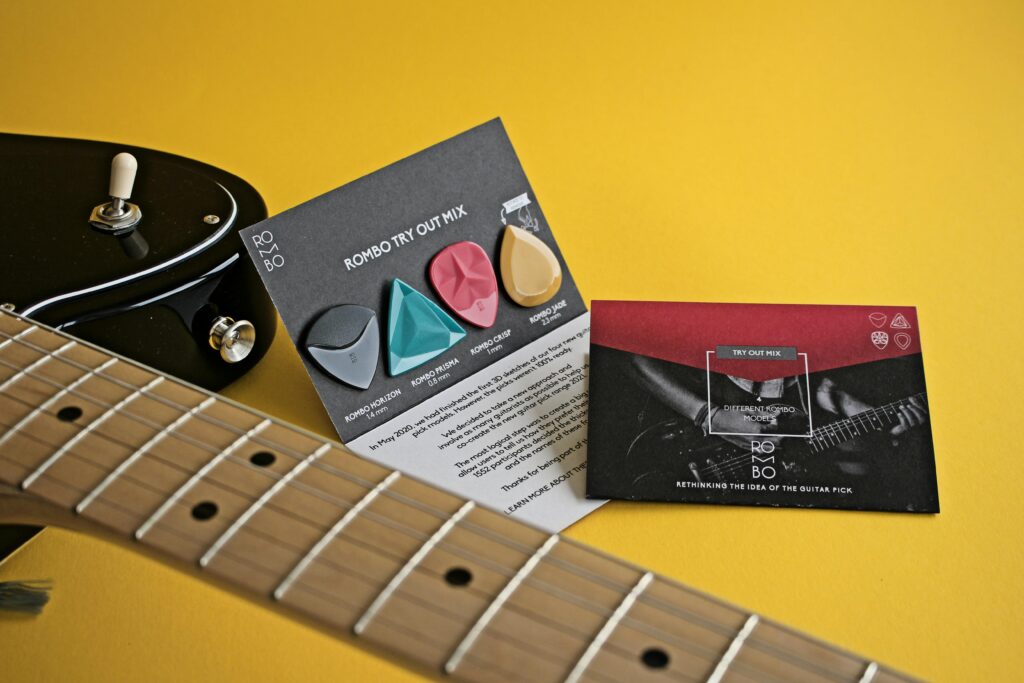
Close-up of guitar and colorful picks on yellow surface, showcasing musical accessories.

Knowing the correct guitar pick for maximum output

Choosing the Right Pick: The Hidden Key to Your Guitar Tone When you’re starting out at StrumEasy, most of your focus is on where your fingers go on the fretboard. But here is a secret every pro knows: your pick is the first point of contact between you and your music. It is the “bridge” that transfers energy from your hand to the strings. Using the wrong pick can make a high-end electric guitar sound dull, or make a fast solo feel like you’re playing through mud. Here is how to find the perfect pick for maximum output and better technique. 1. Thickness Matters (The Gauge) Pick thickness is measured in millimeters (mm). Even a 0.2mm difference can completely change how you play. Thin Picks (0.40mm – 0.60mm): * Best For: Strumming acoustic guitars. The Sound: They have a “percussive” clicky sound that blends beautifully with chords. They are flexible, which means they won’t snag on the strings while you’re rhythmically strumming. Medium Picks (0.70mm – 0.90mm): * Best For: The “All-Rounder.” The Sound: These provide enough stiffness for lead lines but still have enough “give” for strumming. If you only want to carry one pick, this is the gauge. Heavy/Extra Heavy Picks (1.0mm – 2.0mm+): * Best For: Electric guitar solos, Jazz, and Metal. The Sound: Maximum control. A thick pick doesn’t bend, meaning the string moves the second you hit it. This provides the most “output” and volume from your pickups. 2. Shape and Tip Sharpness The shape of the pick determines your accuracy. Standard (351 Shape): The classic heart-shaped pick. Great for beginners because it provides a large surface area to grip. Jazz III Style: These are smaller and have a very sharp tip. Why pros love them: Because the tip is sharp, there is less friction against the string. This allows for “Economy Picking” and “Alternate Picking” at high speeds. At StrumEasy, we recommend these once you start learning fast scales. 3. Material and Texture (The “Grip” Factor) In the heat of a performance (or a long practice session in the Delhi humidity), your hands will sweat. Nylon: Very flexible and durable, but can be slippery. Delrin/Tortex: These have a “powdery” feel that provides excellent grip. Celluloid: The traditional choice that mimics the sound of natural bone or tortoiseshell. Psychology of Performance: If you’re worried about your pick slipping, you’ll unconsciously grip it too hard. This leads to tension in your wrist and forearm, which can cause pain. Finding a pick with a “grippy” texture allows you to keep a relaxed hand, leading to faster playing. 4. How to Find Your “Maximum Output” If you want your electric guitar to sound powerful and punchy: Go Thicker: Switch to at least a 1.0mm pick. Angling: Don’t hit the string flat. Angle the pick slightly (about 30 degrees) toward the headstock. This “slices” through the string rather than slapping it. Point of Contact: Play closer to the bridge for a “bitey” lead tone, and closer to the neck for a warm, jazzy output. Final Thoughts Don’t settle for the random pick the shopkeeper threw in for free. Experiment! Buy a variety pack and spend a week with each one. You’ll be surprised at how much easier your “Strumming” becomes when the “Easy” starts with the right pick. Do you have a favorite pick brand yet, or would you like me to recommend the top 3 brands that are easily available in India for your Monday launch?  

Knowing the correct guitar pick for maximum output Read More »